by
Ryan Clement
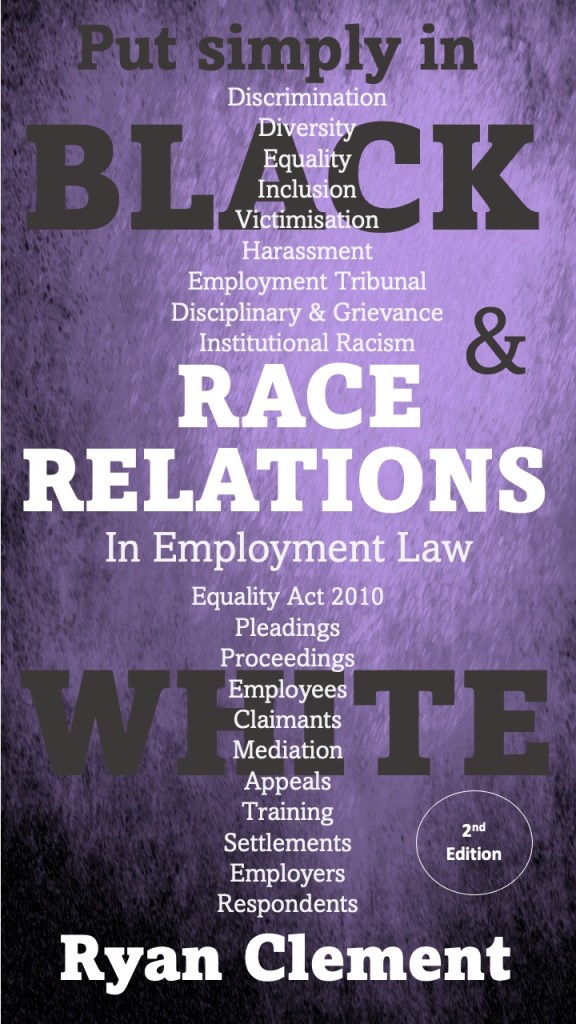
The term, ‘institutional racism,’ was not written about in the first edition of my book, ‘Race Relations in Employment Law – Put Simply in Black and White.‘ It was a conscious decision because, as confirmed by the Employment Appeal Tribunal, “There is no statutory or other offence consisting of a body being institutionally racist.”
However, since its publication the term has been in the headlines for a variety of reasons. In fact, recently, a senior nurse who was employed by NHS England and NHS Improvement Commissioning as a continuing healthcare manager won her case of, amongst other things, discrimination because of race and harassment related to race and reportedly said, “It sadly proves that institutional racism is still present in organisations, despite the efforts to make it more inclusive for people of all races and backgrounds.”
As recently as 21 March 2023, Baroness Louise Casey of Blackstock who undertook an independent review into the Metropolitan Police’s culture and standards following Sarah Everard’s murder, said, ‘she felt not enough had changed since the 1999 Macpherson report, published after the murder of black teenager Stephen Lawrence, which labelled the Met “institutionally racist” – a problem the force is “yet to free itself from”.’
Various institutions are being labelled as “institutionally racist.” However, do we all know what this sensitive and often inflammatory term truly means and what would qualify an institution as being “institutionally racist” or not? Some argue that we do not need to trouble ourselves too much with definitions and labels, and that we need to focus mainly on the relevant policies, attitudes, practices, behaviours, procedures, training, cultures, checks and balances in place etc. I leave that for others to debate.
However, in the meantime, let us remind ourselves of a definition given of ‘institutional racism’ given in The Macpherson Report:
Taking all that we have heard and read into account, we grapple with the problem. For the purposes of our Inquiry the concept of institutional racism which we apply consists of:
The collective failure of an organisation to provide an appropriate and professional service to people because of their colour, culture, or ethnic origin. It can be seen or detected in processes, attitudes and behaviour which amount to discrimination through unwitting prejudice, ignorance, thoughtlessness and racist stereotyping which disadvantage minority ethnic people.
In responding to Baroness Casey ‘s report into the Metropolitan Police, the head of the Metropolitan Police, Sir Mark Rowley, said, “”I don’t use the ‘institutional’ label myself”, arguing that the term is “ambiguous” and “politicised.” Clearly, there will be some who can recite unaided an acceptable definition of institutional racism (like Macpherson) and apply it to a given set of facts to see whether an institution can be fairly, reasonably or arguably be alleged to be ‘institutionally racist.’
HOWEVER, and I cannot stress this firmly enough, it is vitally important that one does one’s homework to enable one to speak with some authority or weight; one way or the other. Simply expressing a view or opinion, whichever view or opinion one holds, without being able to support it with sufficient reasoning and clarity that can be acceptable or challenged will carry as much weight as a house built on sand without any form of foundation or basis on which to sustain it. As Epictetus is quoted as saying, “First learn the meaning of what you say, and then speak.” In this sense, knowledge and understanding is power!
Ryan Clement, LLM, BA, BSc, barrister
https://www.youtube.com/@RyanClement1

Copyright © Ryan Clement 2023

 Ryan Clement