by
Ryan Clement, barrister
RACE RELATIONS law in the United Kingdom. After many years of practising as an employment law barrister, I have sought to encapsulate some of that experience in print, simply put in black and white, that I hope will be of assistance to many, be it an employee – current and former, employer, worker, claimant, respondent, HR, student and, of course, the intrigued. This book introduces the race relations laws in Britain as pertaining to employment. It does not seek to cover every minutiae of this fascinating and intriguing subject; it would take a much larger book to achieve that aim successfully.
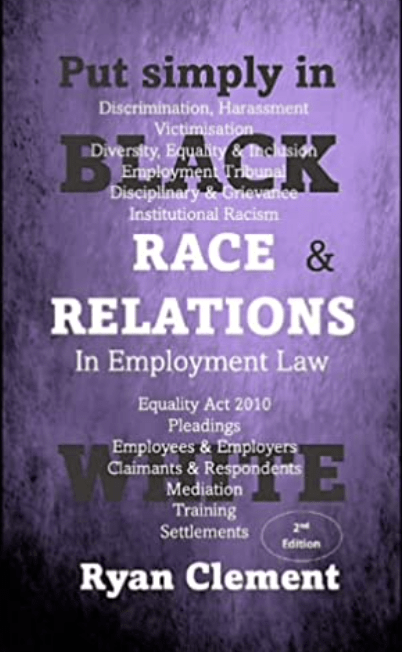
I HAVE BOLDLY attempted to state where I believe it all began. I accept that some, if not many, would disagree with my starting position. But after spending many weeks researching and reading Hansard at my Inns of Court library (the old-fashioned way i.e. without the benefit of an Internet search engine), I reached the conclusion that 12 June 1956 was as good a starting point as any, which I detail in Chapter One (How It All Began). It saddens me somewhat to see that much of what was discussed over 60 years ago with regards to race relations would not look entirely out of place in some discussions taking place today.
THERE IS NO CONSENSUS as to the “correct” place to start when considering the birth of race relations in Britain. Each writer would have their preferable place at which to begin. I have chosen the date and place as 12 June 1956 at the House of Commons when the then Labour Member of Parliament for Eton and Slough, Mr Archibold Fenner Brockway, the son of a Christian missionary, sought leave of the House to introduce his Private Member’s Bill, supported by just eleven other named MPs, among them Mrs Castle and Mr Benn, “to make illegal discrimination to the detriment of any person on the grounds of colour, race and religion in the United Kingdom.”
HOUSE OF COMMONS, First Reading on 12 June 1956, Mr Brockway said:
It is very difficult to estimate opinion on this matter. There are under-currents of feeling, it may even be in the subconscious, which will respond under favourable conditions towards, or retreat under unfavourable conditions from, racial equality. But, Sir, I would say that broadly speaking the British people recognise that identity as human beings is greater than differences of race, colour or religion…I recognise that there must be a limitation of the powers of legislation. Often acts of discrimination are due to prejudice, to ignorance or to irrational repulsion, and those can be removed only by education or experience.
IN TOTAL, Mr Brockway made some 9 attempts to make various forms of race discrimination unlawful; each failing to make its way onto the statute books. However, on 8 November 1965, as predicted by Mr Brockway – albeit not his Bill – on 14 January 1964, the Bill described by Sir Dingle Foot as “a landmark in our legislation” received its Royal Assent and thus became the first race relations legislation in Britain; the Race Relations Act 1965.
https://www.youtube.com/@Law-in-Shorts1
Copyright © Ryan Clement 2024
 Ryan Clement