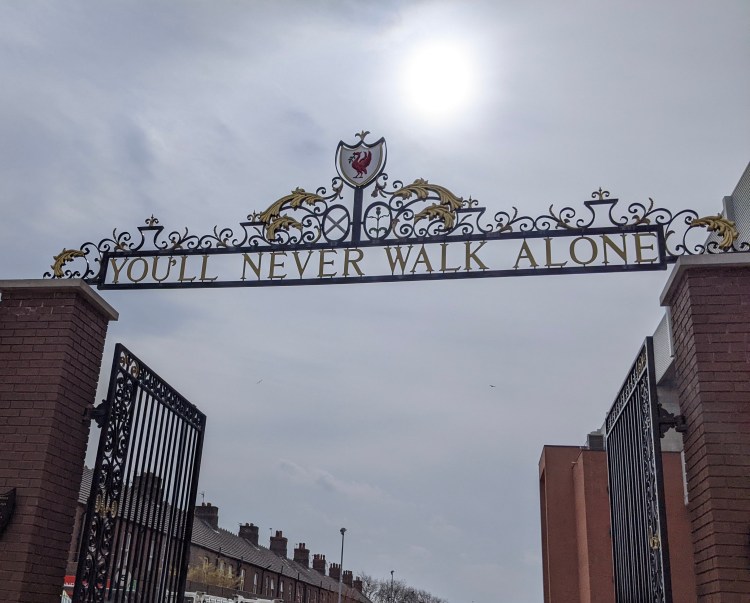
This week I was driving to court. I was thinking about the upcoming ‘Man U’ match and my last trip to Anfield, which was the game against Everton, the Merseyside Derby.
My journey took me through Crystal Palace, where, at Selhurst Park, only the weekend before, Liverpool got a late winner to secure all three points and move them to the top of the Premier League. I was driving to Croydon where I parked my car for court. On my way I noticed flowers and pictures on the other side of the road, my right side. The building was adjacent to where I was going to park, so I parked and walked over. I was reminded of the horror that occurred on 27 September 2023.
Manchester United are, traditionally, a big rival to Liverpool for many reasons. As a Chiswick born person, growing up in Hammersmith and schooled in Fulham, all in London, I have not personally experienced any city-rivalry between the two. Mine is based solely on the football. However, win, lose or draw, I want to see a good game. Yes, I am a Liverpool fan, but the game, rivalry and result must be put in its proper and rightful perspective. As the 57,000 capacity crowd gather to watch the rivals battle it out to either maintain their top spot or move up the table, there are many people suffering horrendous of lives as I right. There are many who will be facing this time of year without a loved one for the first time. They’ll be many who will face this Festive Season – for some who celebrate it – without someone’s joyful smile that was with them only this time last year! My thoughts are with them.
OF COURSE, I don’t really know the answer to this age-old question, but my very good friends, F and M, and I may well have come very close to an – rather than ‘the’ – answer.
WE WERE CELEBRATING A VICTORY in a recent court case. We were enjoying our meal in Wembley – they had kindly made the journey South solely for my convenience. We, sorry, I had elected for an Indian meal. Had I known that F was a regular Master Chef of the dish as often as I am a regular consumer of the cuisine, I would have elected for Thai, followed by Chinese instead. Too late, but that hadn’t damped our wonderful evening of laughter, reminiscence of the case, joking and everything else in between. In fact, to label or limit our evening solely as ‘wonderful’ does not, in any way, do it justice.
ANYWAY, back to the theme of the title. As the evening unfolded and I consumed my chicken Dhansak with pilau rice washed down subsequently with a large glass of cold mango lassi, M revealed that F loved to paint and was an artist. Naturally, I asked to see some of her work, which she showed me on her phone. Magnificent! I was genuinely taken aback. They were colourful, unique and engaging. I loved and love her works of art.
F revealed that she did not have a studio in which to paint and would erect her easel wherever she finds space at the time to create. Whatever the process, it works! We then embarked on, What is Art? To me, Art is anything that is created or arranged in some way that moves someone to react emotionally in some way. I know there is more to this – and tonnes of books on the subject – but that’s my short take on it. We spoke about Marcel Duchamp’s ‘Fountain’ as a case in point, a porcelain urinal signed “R Mutt. 1917” - that’s it! – being a famous work of art. By my definition, a work of art is fluid and may mean different things to different people; even the same piece. Two of us could listen to some music and be moved in different ways or one of us may not be moved at all! I say fluid because I am a big jazz fan today but was not a fan until I saw Randy Crawford and The Crusaders in concert in London. We went to see only the former and ended up falling in love with the latter (we already loved the former!).
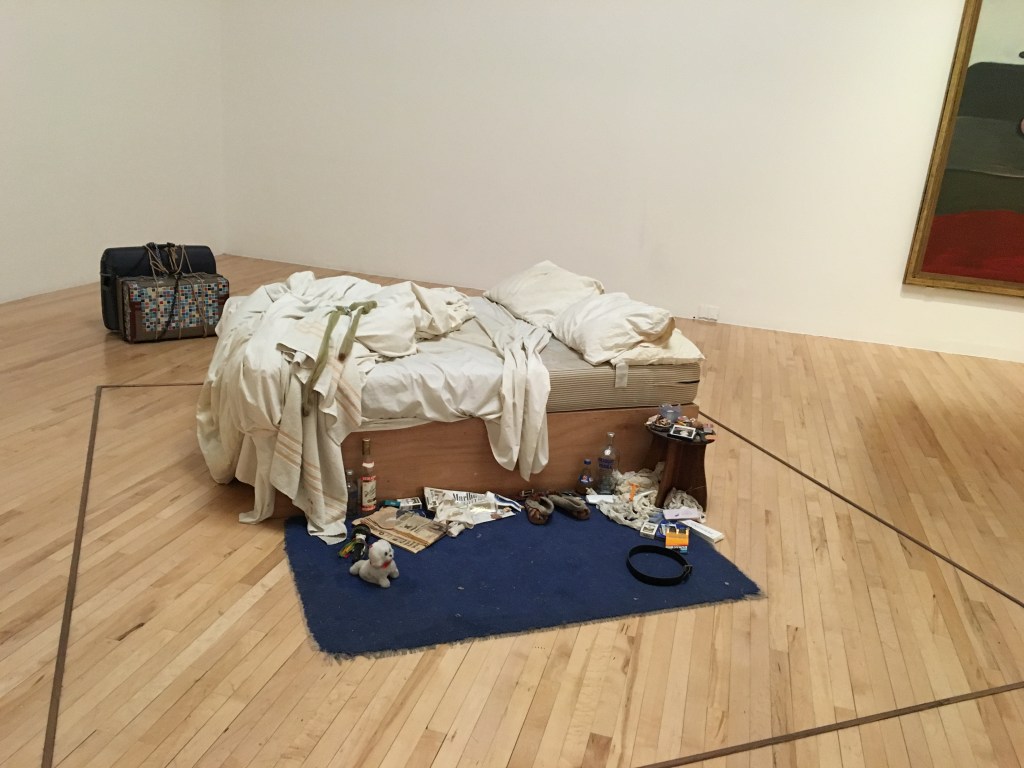
I guess the fluidity of it hit me more when, a few years ago, there was this discussion or debate over what was art? It arose because people were questioning whether some of the works of Damian Hirst and Tracey Emins were truly art. It was topical at the time because of the recent exhibition of Ms. Emins’s ‘My Bed.’ Years later, my soulmate and I visited Tate Britain in London and saw the bed in question, live – until that time I had only seen pictures of it. We tagged on to a group who was having the ‘inspiration’ behind the bed explained. Prior to this, the bed meant nothing to me beyond resembling my messy bed as a teenager – with some exceptions. Then, it changed. It made sense.
One is supposed to separate the Art from the Artist, but on this occasion the story behind the art made me appreciate the art itself or at least understand it. In my mind, at that moment, to ME, it became Art. Why? Because I had a reaction to it in a way that a creative piece – music, film, literature etc. – does. I took this picture of it at the time.
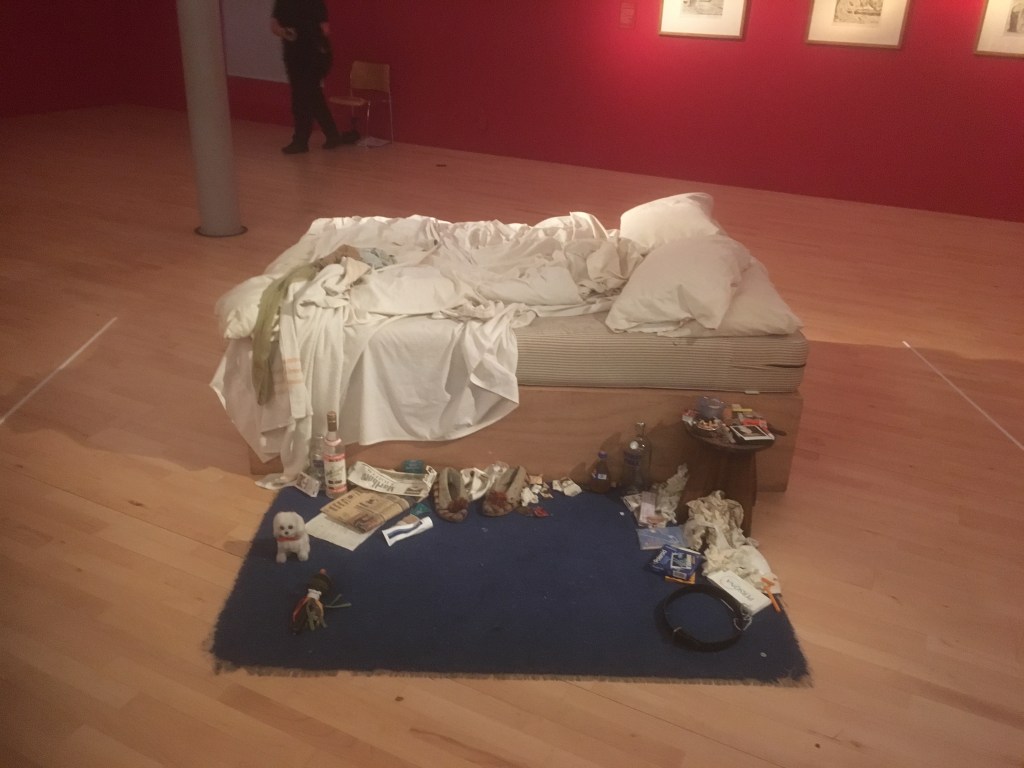
MANY YEARS LATER, the family and I were in Liverpool and visited Tate Liverpool. Unbeknown to me, Ms. Emins’ bed was now being exhibited there. I took a picture and then remembered that I had also taken a picture of her bed in London. You can compare how accurate the two are – between London (above) and Liverpool (below) – or how close she managed to recreate the same.
ANYWAY, back to the evening. We left the restaurant a little jollier than we had when we arrived – which was some achievement because we were already cheerful, jovial and good-humoured before we arrived! However, we were not entirely convinced that we had, in fact, cracked the age-old question of What is Art? But, we had a great time over good food, good talk and, above all, good company trying!
TODAY, 10 December 2023, marks the 75th anniversary of the United Nations Universal Declaration of Human Rights, which came into force in 1948, being just 3 years after the end of World War II.
The Declaration provides that, as human beings, we are entitled to stipulated basic rights regardless of race, colour, religion, sex, language, political or other opinion, national or social origin, property, birth or other status. It has formed the basis of many domestic laws worldwide.
Even the Equality Act 2010 in Britain makes it unlawful to discriminate against another because of protected characteristics, such as:
age;
disability;
gender reassignment;
marriage and civil partnership;
pregnancy and maternity;
race;
religion or belief;
sex;
sexual orientation.
Looks familiar?
Undoubtedly, I think, the Declaration has been influential – I doubt it could have lasted 75 years otherwise – however, I shall leave it to others to debate how influential and, importantly, successful it has been. For certain, it has formed or been influential in forming the basis of many anti-discrimination and Equality laws and declaring basic human rights, but has this been enough? You decide.
As a sports’ fan, As one that attends many live sports’ events with and without my son, As a barrister, As a football fan, As a Liverpool fan, The Hillsborough Disaster was and is immensely painful.
Families of the victims have been pushing for ‘Hillsborough law’ to outlaw alleged police cover-ups after major incidents.
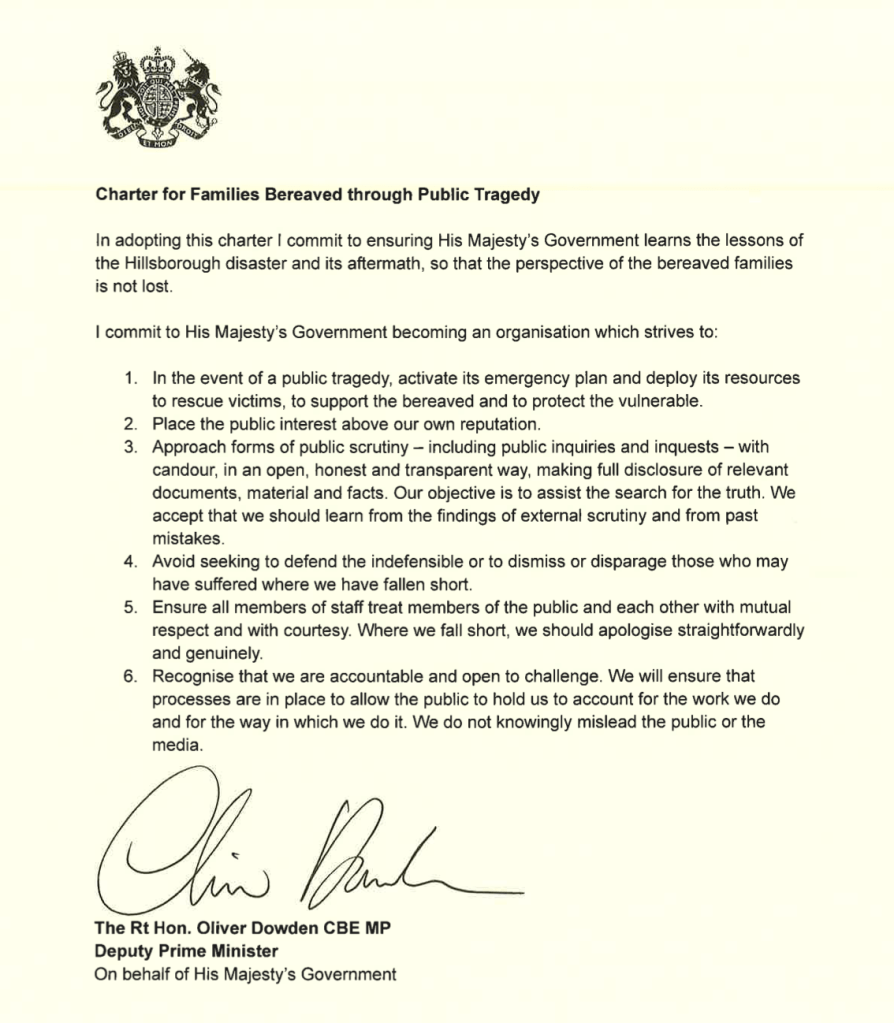
In December 2023 the Government signed the Hillsborough Charter, which stops short of what many wanted.
For those of you who are not familiar with what happened on that tragic day, in brief and in grief, 97 Liverpool fans died as a result of a crush at the Hillsborough stadium in Sheffield during the club’s FA Cup semi-final against Nottingham Forest on 15 April 1989. Gone too soon! 🥲
I am often asked, what is life like at the Bar and I am always more than happy to take time to answer and, if I am asked with the obvious aim or intention of the inquirer’s considering a career in this part of the legal profession, I encourage. It is much better than what I had available 30 years ago. I had and knew no one to approach. Or, better still, no one whom I knew who was approachable or perceived to be as such.
Many years ago I wrote an article titled, ‘How many make it to the Bar?’ – August 2014 Barrister Focus,‘YOUNG LAWYER’ from Solicitors Journal, p13. Although some of the data (and language – I refrain from using the term, ‘BEM,’ or, ‘BAME,’ in my writings today) has since been superseded, the message remains:
“According to the Bar Council’s statistics, of all practising barristers in 2010 (15,387) 10.2 per cent were BME.
Compared with the 2011 census, which recorded that 14 per cent of the population were BME, the Council’s 2010 10.2 per cent figure purports an under-representation. However, one can interpret statistics to support the case it chooses to advance. For example, the above comparison does not take into account regional variations.
Nevertheless, notwithstanding the above comparison, the real question that needs answering is, of those who completed the academic stage of their studies (law degree or graduate diploma in law (GDL)), how many made the transition to practise at the Bar and, if not, why not? If the answer is ‘I have chosen not to because I am not a typical barrister,’ I say think again.
I entered the Bar in 1996 after working in construction management and have as diverse an entry to the profession as most. I completed the GDL on the back of my BSc in Surveying. Having worked in a previous profession and embarking on diverse mini-pupillages undoubtedly helped this transition. This diversity enabled me to attract and be attracted to a wider representation of potential and actual clients.
Many professions, accountancy, surveying, medical, teaching etc., appear to be diversely represented and avoid being perceived as otherwise. It would be a failure of the Bar if some had reason to perceive that barristers were not as diverse in many aspects, be it on gender, race, or university attended, as the public to whom they offer their services.”
🧣 Life of a barrister on match day ⚽️
Depending on your practice, a barrister could be in court almost exclusively such as my Learned Friends at the Criminal Bar or less so at the Civil Bar. As for me, as a Civil law barrister, I have a mixture of being both in court all over the country and advise and draft pleadings extensively that form part of my written work. In my case, that would involve plenty of travelling for court appearances, although hearings being heard over video links have been a blessing by easing the extent of travelling. I remember the days of having to travel 200-300 miles for a 1-2 hours preliminary hearing. Post-2020, such are rare, few and far between. Above all this, it goes without saying that one must be a quick reader, digest and analyse facts quickly, be prepared to read volumes, prepare thoroughly and to be willing to work hard and fight your client’s case ferociously irrespective of your personal views.
A career at the Bar is and can be very rewarding in knowing that you have and can make a real and significant difference to someone’s life. So, if you feel it is a profession for you, NEVER let anyone dissuade you from pursuing your career where you, too, could one day also sign up to making a real and or significant difference to someone’s life.
ON SATURDAY, 21 OCTOBER 2023 I was at Anfield for the 12.30pm kickoff Merseyside derby – Liverpool v Everton. As was expected, there was much banter between the fans, not entirely wishing the other the best. However, on a matter far more serious and important than a sports event, involving two local rival teams, ALL were united as the public announcer said the following:
“Ladies and Gentlemen the thoughts of everybody at Liverpool Football Club are with the innocent civilians, including our supporters who have lost their lives and all the communities impacted by the ongoing crisis in Israel and Gaza. As a mark of respect for all of those affected, the players, managers and match officials are wearing black armbands in today’s game and there will now be a moment of silence, which will start and end on the referee’s whistle.”
PA at Anfield, Liverpool, on 21 October 2023
Following the silence, both sets of players, including the referee, Took the Knee.
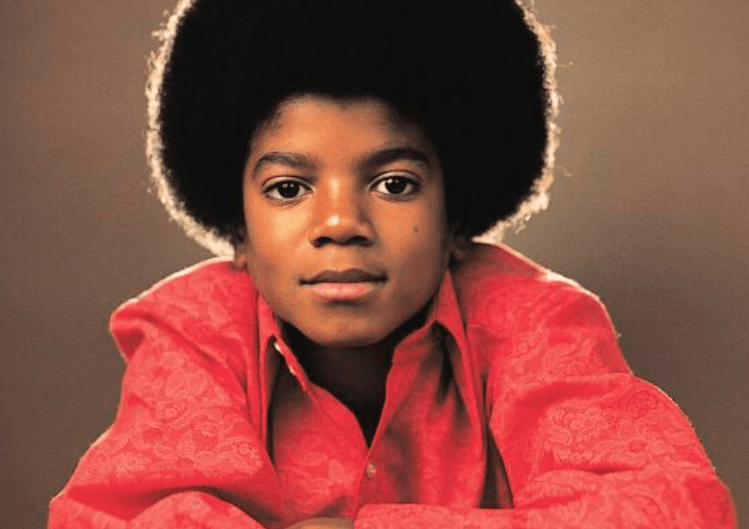
When Jermaine said to his little brother, Michael, in the Jackson 5 song Up on the House Top, “But you just want toys and stuff,” the 12 year old responds, “Yeah, but that’s not even half enough. What I want means more than fun.”
It may have crossed Jermaine’s mind, what could such a young child want that was more than, ‘just toys and stuff,’ pursued and asked his brother, “What’s that?” to which the precocious MJ confirmed, “Love and peace for Everyone!” 🕊️
Image of Michael Jackson is not owned by me and maybe copyrighted
IF YOU ASK many people what they did on a particular day last week, let alone a few years ago, unless something remarkable or exceptional happened or occurred, it is highly unlikely that most, myself included, would be able to recall accurately the events of that week or year. That is why I was able to write about 10 October 1996 when, if only for me, friends and family, something remarkable happened, which is when I was Called to the Bar of England and Wales.
SIMILARLY, I recall where I was in October 1983. Some people would, Most people won’t and All Grenadians should. Although born in London, I am of Grenadian Heritage (Grenada mainland and Carriacou), hence why I should and do. My mother’s friend, Helen, was over at the family home. My mother had just finished doing Miss Helen’s hair and they were engaging in small talk. Naturally, that was no business of mine. Furthermore, children did not hang around much – if at all – when Big People are talking. So, I went into my parents’ bedroom to watch TV. As I was watching, there was breaking news that there was an incident in Grenada. I had to check twice that I heard it correctly because many people – even today – mistake Grenada for Granada. After checking that I had heard clearly that it was the former, I ran into the other room to interrupt the Big People talking to tell them, both of whom are Grenadian, of the news I had heard. I can still the shocked look on their faces, not because I had the front to interrupt them but because of what I had just revealed. We were glued to the television as the news unfolded.
There was an uprising in the up and till then peaceful, small Spice Island. This was a shock. To be honest, I knew very little about the local politics. I had heard of Sir Eric Gairy because his name was mentioned a lot in the household but without my taking any real attention. This short blog is not about the politics of the time about which I know a lot more now and about which much has been written. I am simply writing from the prospective of a young British born person of Grenadian Heritage at the time. Sir Eric Gairy, who led Grenada through its independence from Britain in 1974, became its first Prime Minister in the same year.
I remember my heart racing as, obviously, I understood and sensed the general seriousness of what was happening but neither the context of it or the real gravity. The knowledge of both were gained over the next few days when I heard and read more in the media. I also knew if the then American President, Mr Ronald Reagan, and the then British Prime Minister, Mrs Margaret Thatcher, were discussing it then it must be very serious! The former got the American’s actively involved on the basis, it was reported, of freeing American students on the island who were studying at SGU (St. George’s University).
I had heard of the then Grenadian Prime Minister at the time, Mr Maurice Bishop, but I knew little else. I got to know a lot more fast, very fast. Prime Minister Bishop was a lawyer who studied law in London. In March 1973 the New JEWEL [Joint Endeavor for Welfare, Education, and Liberation] Movement (NJM) was formally established. Mr Bishop was its leader, which became the leading opposition party to that led by Sir Eric Gairy, the GULP (Grenada United Labour Party). However, in March 1979 the New JEWEL party led by Mr Maurice Bishop overthrew Sir Eric Gairy and the GULP in a successful coup d’état. Although, Mr. Lennie Fleary says it was not a coup d’état but it was a revolution. In 1983, which is where this blog began, Prime Minister Bishop was killed.
I have since walked around and visited the scenes of what occurred during that time. Also, I have since walked many times along the old airport, Pearls, where there are still abandoned planes that were part of the conflict. It feels so strange writing this. Firstly, what happened 40 years ago is so at odds with the tiny peaceful, Spice Island I know and love today. Secondly, whenever I walk along the airport strip at Pearls, I recall being a 10 year old who had travelled with my mother and landing on that very same strip. I recall leaving and waving to my late grandmother as we boarded the little plane headed for Barbados to catch the connecting jumbo, heading for London. It was at that airport I last set eyes on my late-grandmother, Nenen.
I have shied away from expressing any political opinion about an issue I have since heard plenty about but about which I am not qualified to express any opinion that would carry any weight or have any value. However, as is well documented, it would be fair to say that President Reagan was not too pleased with Prime Minister Bishop for engaging Cubans to help construct a new and international airport at Point Salines in Grenada. It is reported that President Reagan was concerned that the Bishop Government would allow the Soviet Union to use it en route to Cuba. Ironically, in 2009 Point Salines Airport was remained Maurice Bishop International Airport, which is on Maurice Bishop Memorial Highway.
A fascinating Chat with Mr. Lennie Fleary, a Former Grenada Consul General in Toronto
In August 1997 aged 75, Sir Eric Gairy passed away in Grenada. Like Dr. Martin Luther King Jr. and Mr. Malcolm X (also of Grenadian heritage), Mr. Bishop lived to see his 39th birthday. But, also like Martin Luther King and Malcolm X, he would be assassinated before his 40th!
I AM TOLD that most men will die with prostate cancer than from it. We all, I believe, are far more enlightened and educated about PC than, say, 10 years ago. However, sadly, I find that there are still two camps amongst us; those who know and have regular checks and those who know but simply do not care. This short blog is for the latter.
I am no expert on the subject but have had personal experiences of it. To put it crudely, if every male had to experience one cancer in their lives PC would probably be the one. Why? Because it is curable if caught early. AND, we should ALL be seeking to catch it early if we are of the 1 in 8 (12.5%) (some say 1 in 7 – 14%) of ALL men in the U.K. who will get PC. AND, 1 in 4 (25%) of black men will get it. These statistics are frightening!
However, there is ABSOLUTELY no excuse for not asking for/having regular checks, for example, of your PSA; if you have a family history of PC; or if you have or believe you have related symptoms. According to to NHS.U.K.:
Prostate cancer does not usually cause any symptoms until the cancer has grown large enough to put pressure on the tube that carries urine from the bladder out of the penis (urethra).
Symptoms of prostate cancer can include:
needing to pee more frequently, often during the night
FINALLY, putting aside that I write about many topics other than just law, employment, HR etc, in case anyone is thinking what has PC to do with any of them, it has EVERYTHING to do with them. As will be seen in my next publication (out soon!), cancer is deemed a disability under the Equality Act 2010. In other words, a person with prostate cancer would not need to prove/satisfy the, “substantial and long-term adverse effect on [their] ability to carry out normal day-to-day activities,” parts of the disabled definition.
You know it makes sense!
Just do it!
NO COPYRIGHT (ONE’S/YOUR LIFE IS MORE IMPORTANT) – PLEASEFEEL FREE TO SHARE THIS AMONGST BOTH YOUR MALE and FEMALE FAMILY MEMBERS, FRIENDS AND LOVED ONES ❤️
THIS IS A STORY about the beginning as the Ancient Greeks perceived it to be. Today, we put it in the draw of mythology, Greek Mythology. In fact, the ensuing Romans didn’t dispute much of it either apart from changing a name here and there such as the Greek Uranus to Roman Neptune. I like originals, so I shall keep mainly to the Greek names but shall refer to the Roman counterparts later. So, here goes.
It’s hard to imagine this but there was once Chaos. Not the type of chaos we see in the world today but a type of emptiness. I know it seems hard to picture how chaos could be empty, but it is not for our modern human minds necessarily to get our heads around. It’s like mathematics, you simply accept that 22 over 7 is okay to use for Pi or that there are precisely 365 and one quarter days in the year without question. You learn it, memorise it and accept it.
So, according to the Greeks, Chaos was there alone. And Chaos was chaotic. Chaos was its raison d’être. I am guessing here but at some point I presume that Chaos wanted some order in its life. So, it created or formed – the precise verb is not essential – Gaia, Mother Earth, who was joined by Uranus (like I said, also known as Neptune by the Romans), god of the sky. They were joined by a dark unpleasant underworld beneath the Earth named Tartarus, an evil place. Others joined in also such as Hemera, Aether, Nyx and Erebus representing and being Day, Light, Night and Darkness respectively. Naturally, these were the first of their kind. These were Goddesses and Gods. The first EVER! So, in order to distinguish them from the gods they begat and those to follow, we called them Primordial deities. Interestingly, they could also take bodily forms.
Now we introduce the next tier of gods. Initially, Gaia and Uranus produced 12 giant beings – half a dozen males and females each – named, eventually, as the Titans. Amongst them were Rhea, Lapitus andthe youngest, Cronus.Sadly, Uranus wasn’t fatherly and left the children’s upbringing to Gaia. Additionally, he was cruel to his offspring and didn’t even like the look of them. His view wasn’t helped by the appearance of his and Gaia’s next produce, being three giant Cyclopes (one eye!) and three Hecatoncheires (fifty heads and hundred hands giants!). Due to Uranus’ cruelty, Cronus, leading amongst his siblings together with his mother’s blessing, plotted to kill their father. Matters did not result in patricide, but a wounded Uranus fled.
The power vacuum created by Uranus’ departure was filled naturally by Cronus, as he had elected riskily to take on his father and conquered. Siblings Cronus and Rhea formed a union. However, due to a prophecy Cronus feared that one of his children would dethrone him – not too far removed from what he had in mind for his own father. His prognosis was to eat his children shortly after birth. After their fifth child had been consumed by the father, being Hestia, Demeter, Hera, Poseidon and Hades, Rhea conspired with her mother, Gaia, to give birth to Zeus in Crete, which wasfar removed from the eyes and, more importantly, the mouth of the child’s father. As had occurred before, after his child’s birth Cronus expected his infantile feast. However, Rhea was one step ahead of her husband and wrapped a stone from the mountainside in baby clothes. She handed it to Cronus who unduly consumed the stone, believing it to be Zeus. There the story remains until Zeus grows up and becomes a strong man.
Like Father, Like Son. As was his father, Cronus was cruel. In addition to what he did to his children he had imprisoned his younger brothers Cyclopes and Hecatoncheires in Tartarus. Again, as his father had once done, Zeus sought to deal with his father. An admirer of his, Metis,prepared a vomiting potion and, by Zeus’ disguising himself as a servant, sneakily poured the potion into his father’s wine, which Cronus drank. After a brief while Cronus vomited the stone followed by the regurgitation of Zeus’ five siblings. Zeus also freed his imprisoned uncles the Cyclopes and Hecatoncheires from Tartarus for which, naturally, they were grateful and loyal to him.
Again, Like Father, Like Son (not to mention that Zeus – with his extramarital affairs – also married his sister, Hera). As had Cronus, the youngest of the Titans at the time, Zeus, the youngest of his family, became the Chief among the rulers of the new world. He created a place at Mount Olympus in Olympia for the gods, whom he named Olympians, to reside at. The twelve Great Gods of the Olympians were from, at any one time (Roman equivalent in brackets), Zeus (Jupiter) – King of the Gods, Sky, Thunder and Lightening; Aphrodite (Venus) – Goddess of Love and Beauty; Apollo (Apollo) Ares (Mars) – God of War; Artemis (Diana) – Moon and Hunting; Athena (Minerva) – Goddess of War; Demeter (Ceres) – Harvest; Dionysus (Bacchus) – Wine; Hades (Pluto) – Underworld; Hephaestus (Vulcan) – Fire and Metalworking; Hera (Juno) – Queen of the Gods, Marriage and Childbirth; Hermes (Mercury) – Trade; Poseidon (Neptune) – Sea; and, occasionally, Hestia (Vesta) – Architecture, Family, Hearth and State.
Putting aside Rhea, understandably, the Titans supported by Cronus was unhappy by Zeus’ coup and were envious of the Olympians. There ensued a decade long war (Incidentally, the same duration as the Trojan War!)between the Titans and the Olympians – to term Clash of the Titans has been somewhat confusing! Grateful for their release by Zeus, the Cyclopes and Hecatoncheires sided with their nephew against their siblings. It was a bloody battle but, despite Lapitus’ son, Atlas’ (a Titan in his own right), gallantry (or foolhardiness) in leading the Titans to war, if the prophecy were to be fulfilled, there could be only one winner, ultimately, and that was Zeus! So it was prophesied and so it was done.
For Atlas’ part, he was punished by his having to bear the weight of the Heavens on his shoulder. As the legal concept of spent convictions had not yet been conceived at that time, as seen by many ancient and modern sculptures and paintings alike, that sentence holds firm even today!
Powerful speeches are timeless and can be listened to over and over again without wear, erosion, boredom or losing relevance. They transcend over many, too many to mention. In my view, no consideration would be complete without Dr King’s famous “I Have a Dream” speech.
It is one of those speeches that moves you on multiple levels and speaks to us all. It does something that many good speeches cannot. Its literary content is as good in print as it is delivered by its author’s powerful oratory. Some speeches catapult some to heights never experienced by many (or any) before: The Speech that Made Obama President. And, yet, some statements are simply memorable no matter how brief. For example, how many of us can recall what Neil Armstrong said either side of his famous “It’s one small step for man. One giant step for Mankind” or the same for John F. Kennedy’s famous, “Ask not what your country can do for you – ask what you can do for your country“? I doubt many.
The most powerful of speeches have been known to move the most hardened amongst us to tears. It is a skill that so few possess (Nelson Mandela, Mahatma Gandhi etc) and so many admire. It brings that age old question to the fore of nature v nurture. Are these orators born or made? I say both! For sure, repetition has its place. Tony Blair, known as a powerful orator (an art I experienced personally when I attended a speech he gave one evening before he became Prime Minister), used the advocatory tool – state thrice – emphatically with his “Education! Education! Education!” or devastatingly with his “Weak! Weak! Weak!” attack on the then Prime Minister, John Major MP.
Our TV and silver screens are full of courtroom dramas and the skilled advocate who makes the difference between a guilty and not guilty verdict. However, long before I was Called to the Bar I recall being moved by the power of persuasion – albeit Hollywood’s take – by Henry Fonda, the juror, in 12 Angry Men. That was not before a large audience (only before 11 ‘angry’ men) but he made a difference to one person’s life (death sentence for a guilty verdict!). That made Fonda’s perseverance and reasoning (tools well known in advocacy) worthwhile. It is being prepared to be a minority voice, if necessary, to advocate with reason and force.
Amongst many others in many languages and for many reasons – political and non-political – these well known statements and speeches will undoubtedly remain with us for as long as the art of oratory and advocacy has the ability to continue to move, persuade and be admired by us.












 Ryan Clement