“WHISTLEBLOWING” IN EMPLOYMENT AND THE WORKPLACE

by

Ryan Clement

IN THIS ARTICLE, I am going to discuss, ‘Whistleblowing,’ from an employment perspective. 

FIRST THING to make clear are two things. It’s not about actually blowing a whistle to one’s employer, although, of course, there is nothing in law preventing a worker from doing so when disclosing information about a wrongdoing. Second, which might come as a surprise to some people. If you search your statute books for the title, ‘whistleblowing,’ you’ll be searching in vain because it is not its proper name. The law is in fact found under the less flattering title, ‘Public Interest Disclosure,’ within the Employment Rights Act 1996

EFFECTIVELY, as we shall discuss, ‘whistleblowing,’ is revealing something to an appropriate authority, which may include one’s employer or someone for whom one works, but not necessarily so, about a prescribed set of wrongdoing, the whistleblower believes has taken place, which is in a public interest. The whistleblower is then protected from suffering any harm from, say, the employer or, for that matter, anyone who engages them for blowing the whistle. 

Such harm could be, for example, dismissal, no pay rise, no promotion, but not limited to these. This area of law is highly technical, but I shall break it down to aid one’s understanding and to make it as palatable as I can to enlighten you of this very important area of law. 

NOT every alleged perceived wrongdoing would amount to ‘whistleblowing’ under the Employment Rights Act 1996. It must be one that qualifies. If it does not qualify, then the worker runs the risk of not being protected in law from suffering a detriment or being dismissed based on what may have been nothing more than a bare complaint. 

So, what makes a disclosure of information qualify as being a public interest disclosure, a.k.a. ‘whistleblowing’? There was much debate a few years ago as to what amounts to information. For example, is information only one of fact or opinion, or can it be a mixture of the two, i.e. fact and opinion? It is widely accepted as being the first and last, i.e. fact or a mixture of fact and opinion. Importantly, however, the whistleblower need not be an employee. It is enough for the person to be a worker, i.e., in general terms, someone under a contract who undertakes to do the work personally. 

Whistleblowing by Ryan Clement

THE ALLEGED WRONGDOING must be in the public interest. In other words, if it is an alleged wrongdoing that amounts to a personal matter and no more, the disclosure of information will not amount to, ‘whistleblowing,’ in law and, more to the point, will not afford the worker the statutory protection and or rights under our discussion. So, a complaint that one’s employer has run out of tea bags or failed to stock up on Earl Grey in the staff Canteen, important as they may be to some, is highly unlikely to be in the public interest. So, what qualifies as a disclosure of information? 

A qualifying disclosure of information is one where, in the reasonable belief of the whistleblower, reveals at least one of the following alleged wrongdoing: a criminal offence; a failure to comply with an illegal obligation; a miscarriage of justice; endangering a person’s health and safety; damaging the environment; or concealing any of these. 

IMPORTANTLY, it is immaterial whether what is alleged is true or false. As stated already, the worker is protected if they ‘whistleblew’ in the reasonable belief that the malpractice in question had occurred, occurs or would occur. 

The question I hear, therefore, is, ‘Why whistle blow in the first place?’ Unfortunately, I don’t have an answer for that because that is a, ‘How long is a piece of string?’ type of question. It could be moral, ethical, legal, and in some cases, financial, as well as a mixture of them all. 

In the US, for example, in some cases, you can make a financial claim for whistleblowing. But I am not here to discuss the reasons for people acting the way they do. So, let’s consider the consequences of ‘whistleblowing.’

PUT SIMPLY, if you have made a qualifying disclosure, you are protected from suffering a detriment or being dismissed. Effectively, a detriment is anything short of a dismissal. So, what is the approach adopted by the court in determining whether a ‘whistleblower’ has so been treated? 

Well, if the reason, or if more than one, the principle reason, for the dismissal is that the ‘whistleblowing-employee’ made a protective disclosure, they will be deemed to have been unfairly dismissed. Note that a stipulated two years’ continuous employment does not apply to qualify for protection from being unfairly dismissed and damages are not capped as in ordinary unfair dismissal cases. 

In the case of the ‘whistleblowing-worker,’ that person is deemed to have suffered a detriment if there has been any act or any deliberate failure to act by the employer on the grounds that the worker made a protective disclosure. 

I hope this has been helpful in what is a highly technical area of law

UNTIL NEXT TIME!

Ryan Clement, LLM, BA, BSc, FRSA barrister

Podcast on Apple

Copyright © Ryan Clement 2024

THE VERDICT

by

Ryan Clement, LL.M., BA., BSc., FRSA, barrister

UNLIKE within some jurisdictions (where some jurors become celebrities in their own right if chosen for high-profile cases), we in the UK are not privy to the deliberations of a jury. If you haven’t yet watched or heard Channel 4’s experiment in, ‘The Jury; Murder Trial,’ and are in a place where it can be aired, I urge you strongly to invest 200 minutes, spread over four parts, of your time to watch or listen to it. Personally, and professionally, I found it interesting, intriguing and disturbing in many ways. 

I often train managers on dealing with evidence when conducting grievance and disciplinary hearings in the workplace, and how to seek to arrive at findings of facts on which to base their conclusions.

HOWEVER, without wanting to spoil it for those yet to watch or listen to The Jury, it soon becomes apparent that the evidence – the starting point or foundation from which one (the juror) is supposed to build and formulate within their own minds what they believed happened, as a matter of fact – gets relegated in place of and substituted for matters unconnected (and at times unrelated) to the actual evidence before them (i.e. based on issues that happened outside of the courtroom itself). We all have our biases, whether we are conscious of them or not – hence the term ‘unconscious bias,’ of course. But, sorry for the spoiler, what struck me, was the degree of influence by the louder (or loudest) and the more frequently spoken of the jurors over the perceivably quieter (or quietest) and less vocal. I can see how one can perceive the former as bullying the latter into coming round to their (the former’s) way of thinking or desired outcome. 

ALSO, another thought occurred to me. If not feeling bullied, the latter could mistakenly take the frequently-talking-loudly-former as somehow possessing superior knowledge on the interpretation of the evidence heard or, worse, having special insight on the case and the law. I daresay that this pattern of behaviour is not confined solely to a jury’s room. But what was troubling, amongst many other things, is in a criminal trial, someone’s liberty is often at stake, and if not so, their reputation and or they face future adverse repercussions based on decisions that were influenced by some personal experience of a juror, the aired views of the loudest, the frequency of one’s verbal contribution etc. I would also add, the confidence or the lack of confidence of a juror could (and did, in my view, in The Jury) play a significant part on whether a defendant is deemed to be guilty or not of the offence in question.

But haven’t we forgotten something? Where does the evidence fit it? Answer? I have no idea. Why? Because unlike with civil cases – the jurisdiction within which I practice – juries do not give reasons for their verdict. They are no published facts found by them. We jump from evidence to verdict: ‘Guilty!’ or ‘Not Guilty!’ No ‘Why?’ or ‘How?’ An innocent person could be found to be guilty of an offence and, yet, have absolutely no idea as to how the evidence against them was interpreted or weighed by those 12 privileged members of the jury or why the evidence was found against them. Could you imagine such torment? Innocent and yet found guilty but have no idea how or why your peers arrived at that conclusion beyond the evidence heard – true or false – and, therefore, unable to challenge parts to prove your innocence or fight for your freedom! 

You may well, therefore, ask yourself whether the current jury system is fit for purpose! 🤔

https://www.channel4.com/programmes/the-jury-murder-trial

Copyright © Ryan Clement 2024

Seasons Greetings

by

Ryan Clement

SEASONS GREETINGS TO ALL!

I HAVE MANY FRIENDS who celebrate Christmas and many who don’t, both from a religious perspective and some for other reasons. Whatever your beliefs, convictions and or plans, I wish you all well during these challenging times worldwide.

IF YOU PLAN to celebrate during this Festive Season or not, for whatever personal beliefs you hold, whatever you do, I wish you Good Health, have a Good Time, and please Be Safe!

Peace 🕊️

Copyright © Ryan Clement 2023

Why?

by

Ryan Clement

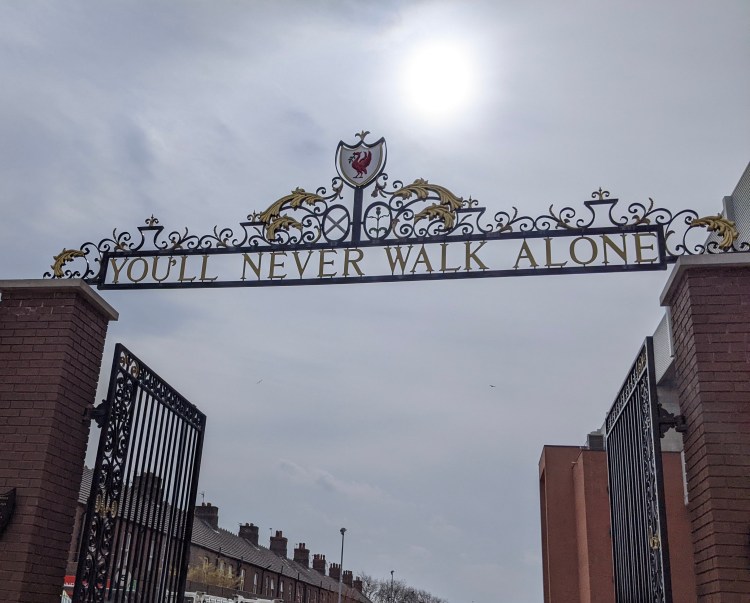
ON SUNDAY, 17 December 2023, all being well, I shall be at Anfield for the match between Liverpool and Manchester United to which I am very much looking forward.

This week I was driving to court. I was thinking about the upcoming ‘Man U’ match and my last trip to Anfield, which was the game against Everton, the Merseyside Derby.

My journey took me through Crystal Palace, where, at Selhurst Park, only the weekend before, Liverpool got a late winner to secure all three points and move them to the top of the Premier League. I was driving to Croydon where I parked my car for court. On my way I noticed flowers and pictures on the other side of the road, my right side. The building was adjacent to where I was going to park, so I parked and walked over. I was reminded of the horror that occurred on 27 September 2023.

It was the site where a beautiful 15 years young schoolgirl, Elianne Andam, lost her life in the most tragic circumstances. Her future was taken away from her when her life was needlessly taken away. It was devastating to be at a site of this tragedy, this horror. It was painful at the time when the news broke on social media, newspapers, television and radio. It was worse, standing at the actually site where one day she said goodbye to her family to embark on her journey to school, embark on her studies to shape her bright future. She was never to return. How very very cruel. Why?

Manchester United are, traditionally, a big rival to Liverpool for many reasons. As a Chiswick born person, growing up in Hammersmith and schooled in Fulham, all in London, I have not personally experienced any city-rivalry between the two. Mine is based solely on the football. However, win, lose or draw, I want to see a good game. Yes, I am a Liverpool fan, but the game, rivalry and result must be put in its proper and rightful perspective. As the 57,000 capacity crowd gather to watch the rivals battle it out to either maintain their top spot or move up the table, there are many people suffering horrendous of lives as I right. There are many who will be facing this time of year without a loved one for the first time. They’ll be many who will face this Festive Season – for some who celebrate it – without someone’s joyful smile that was with them only this time last year! My thoughts are with them.

PS The Liverpool v Manchester United finished 0-0

Copyright © Ryan Clement 2023

What is Art?

by

Ryan Clement

OF COURSE, I don’t really know the answer to this age-old question, but my very good friends, F and M, and I may well have come very close to an – rather than ‘the’ – answer.

WE WERE CELEBRATING A VICTORY in a recent court case. We were enjoying our meal in Wembley – they had kindly made the journey South solely for my convenience. We, sorry, I had elected for an Indian meal. Had I known that F was a regular Master Chef of the dish as often as I am a regular consumer of the cuisine, I would have elected for Thai, followed by Chinese instead. Too late, but that hadn’t damped our wonderful evening of laughter, reminiscence of the case, joking and everything else in between. In fact, to label or limit our evening solely as ‘wonderful’ does not, in any way, do it justice.

ANYWAY, back to the theme of the title. As the evening unfolded and I consumed my chicken Dhansak with pilau rice washed down subsequently with a large glass of cold mango lassi, M revealed that F loved to paint and was an artist. Naturally, I asked to see some of her work, which she showed me on her phone. Magnificent! I was genuinely taken aback. They were colourful, unique and engaging. I loved and love her works of art.

F revealed that she did not have a studio in which to paint and would erect her easel wherever she finds space at the time to create. Whatever the process, it works! We then embarked on, What is Art? To me, Art is anything that is created or arranged in some way that moves someone to react emotionally in some way. I know there is more to this – and tonnes of books on the subject – but that’s my short take on it. We spoke about Marcel Duchamp’s ‘Fountain’ as a case in point, a porcelain urinal signed “R Mutt. 1917” - that’s it! – being a famous work of art. By my definition, a work of art is fluid and may mean different things to different people; even the same piece. Two of us could listen to some music and be moved in different ways or one of us may not be moved at all! I say fluid because I am a big jazz fan today but was not a fan until I saw Randy Crawford and The Crusaders in concert in London. We went to see only the former and ended up falling in love with the latter (we already loved the former!).

I guess the fluidity of it hit me more when, a few years ago, there was this discussion or debate over what was art? It arose because people were questioning whether some of the works of Damian Hirst and Tracey Emins were truly art. It was topical at the time because of the recent exhibition of Ms. Emins’s ‘My Bed.’ Years later, my soulmate and I visited Tate Britain in London and saw the bed in question, live – until that time I had only seen pictures of it. We tagged on to a group who was having the ‘inspiration’ behind the bed explained. Prior to this, the bed meant nothing to me beyond resembling my messy bed as a teenager – with some exceptions. Then, it changed. It made sense.

One is supposed to separate the Art from the Artist, but on this occasion the story behind the art made me appreciate the art itself or at least understand it. In my mind, at that moment, to ME, it became Art. Why? Because I had a reaction to it in a way that a creative piece – music, film, literature etc. – does. I took this picture of it at the time.

MANY YEARS LATER, the family and I were in Liverpool and visited Tate Liverpool. Unbeknown to me, Ms. Emins’ bed was now being exhibited there. I took a picture and then remembered that I had also taken a picture of her bed in London. You can compare how accurate the two are – between London (above) and Liverpool (below) – or how close she managed to recreate the same.

ANYWAY, back to the evening. We left the restaurant a little jollier than we had when we arrived – which was some achievement because we were already cheerful, jovial and good-humoured before we arrived! However, we were not entirely convinced that we had, in fact, cracked the age-old question of What is Art? But, we had a great time over good food, good talk and, above all, good company trying!

Copyright © Ryan Clement 2023

U.N. Declaration of Human Rights

by

Ryan Clement

TODAY, 10 December 2023, marks the 75th anniversary of the United Nations Universal Declaration of Human Rights, which came into force in 1948, being just 3 years after the end of World War II.

The Declaration provides that, as human beings, we are entitled to stipulated basic rights regardless of race, colour, religion, sex, language, political or other opinion, national or social origin, property, birth or other status. It has formed the basis of many domestic laws worldwide.

For example, ‘The Convention for the Protection of Human Rights and Fundamental Freedoms, better known as the European Convention on Human Rights, was opened for signature in Rome on 4 November 1950 and came into force on 3 September 1953. It was the first instrument to give effect to certain of the rights stated in the Universal Declaration of Human Rights and make them binding.’

Even the Equality Act 2010 in Britain makes it unlawful to discriminate against another because of protected characteristics, such as:

  • age;
  • disability;
  • gender reassignment;
  • marriage and civil partnership;
  • pregnancy and maternity;
  • race;
  • religion or belief;
  • sex;
  • sexual orientation.

Looks familiar?

Undoubtedly, I think, the Declaration has been influential – I doubt it could have lasted 75 years otherwise – however, I shall leave it to others to debate how influential and, importantly, successful it has been. For certain, it has formed or been influential in forming the basis of many anti-discrimination and Equality laws and declaring basic human rights, but has this been enough? You decide.

Copyright © Ryan Clement 2023

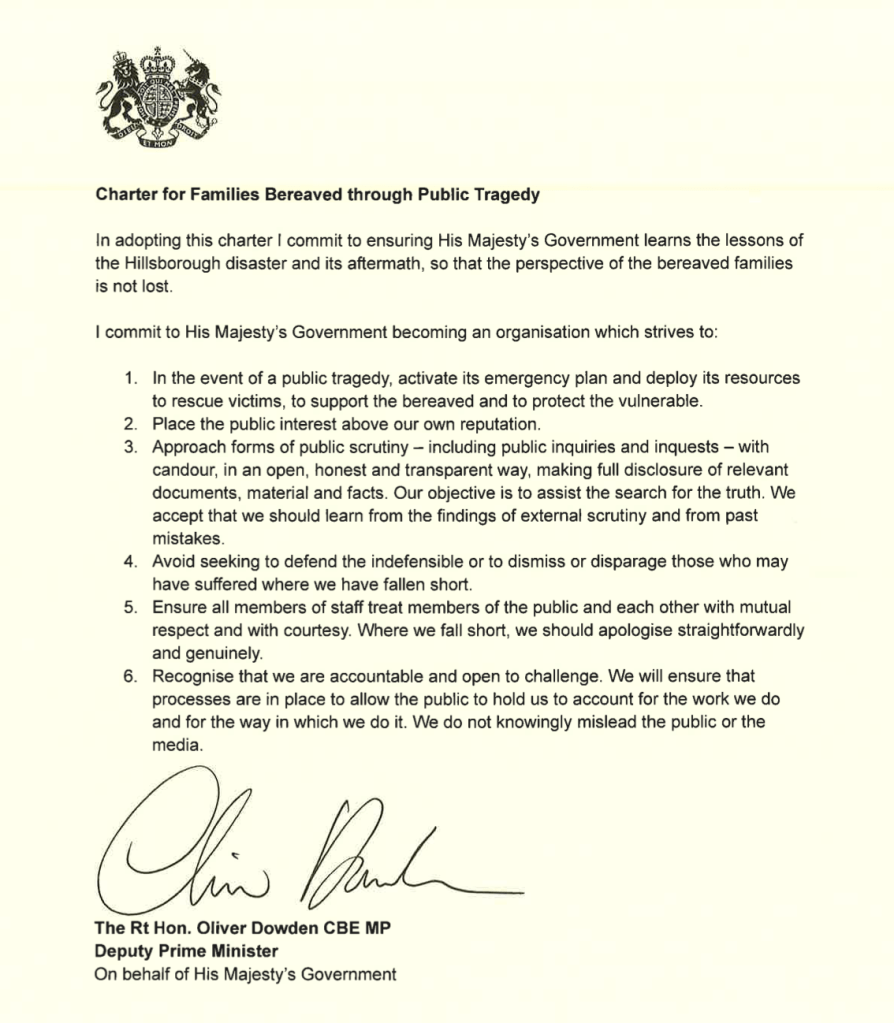
Hillsborough Charter

by

Ryan Clement

As a sports’ fan, As one that attends many live sports’ events with and without my son, As a barrister, As a football fan, As a Liverpool fan, The Hillsborough Disaster was and is immensely painful.

Families of the victims have been pushing for ‘Hillsborough law’ to outlaw alleged police cover-ups after major incidents.

In December 2023 the Government signed the Hillsborough Charter, which stops short of what many wanted.

For those of you who are not familiar with what happened on that tragic day, in brief and in grief, 97 Liverpool fans died as a result of a crush at the Hillsborough stadium in Sheffield during the club’s FA Cup semi-final against Nottingham Forest on 15 April 1989. Gone too soon! 🥲

Hillsborough Disaster

Hillsborough Charter – TikTokPart 1 and Part 2

Copyright © Ryan Clement 2023

Life at the Bar

by

Ryan Clement, barrister

I am often asked, what is life like at the Bar and I am always more than happy to take time to answer and, if I am asked with the obvious aim or intention of the inquirer’s considering a career in this part of the legal profession, I encourage. It is much better than what I had available 30 years ago. I had and knew no one to approach. Or, better still, no one whom I knew who was approachable or perceived to be as such.

Many years ago I wrote an article titled, ‘How many make it to the Bar?’ – August 2014 Barrister Focus,‘YOUNG LAWYER’ from Solicitors Journal, p13. Although some of the data (and language – I refrain from using the term, ‘BEM,’ or, ‘BAME,’ in my writings today) has since been superseded, the message remains:

“According to the Bar Council’s statistics, of all practising barristers in 2010 (15,387) 10.2 per cent were BME.

Compared with the 2011 census, which recorded that 14 per cent of the population were BME, the Council’s 2010 10.2 per cent figure purports an under-representation. However, one can interpret statistics to support the case it chooses to advance. For example, the above comparison does not take into account regional variations.

Nevertheless, notwithstanding the above comparison, the real question that needs answering is, of those who completed the academic stage of their studies (law degree or graduate diploma in law (GDL)), how many made the transition to practise at the Bar and, if not, why not? If the answer is ‘I have chosen not to because I am not a typical barrister,’ I say think again.

I entered the Bar in 1996 after working in construction management and have as diverse an entry to the profession as most. I completed the GDL on the back of my BSc in Surveying. Having worked in a previous profession and embarking on diverse mini-pupillages undoubtedly helped this transition. This diversity enabled me to attract and be attracted to a wider representation of potential and actual clients.

Many professions, accountancy, surveying, medical, teaching etc., appear to be diversely represented and avoid being perceived as otherwise. It would be a failure of the Bar if some had reason to perceive that barristers were not as diverse in many aspects, be it on gender, race, or university attended, as the public to whom they offer their services.”

🧣 Life of a barrister on match day ⚽️

Depending on your practice, a barrister could be in court almost exclusively such as my Learned Friends at the Criminal Bar or less so at the Civil Bar. As for me, as a Civil law barrister, I have a mixture of being both in court all over the country and advise and draft pleadings extensively that form part of my written work. In my case, that would involve plenty of travelling for court appearances, although hearings being heard over video links have been a blessing by easing the extent of travelling. I remember the days of having to travel 200-300 miles for a 1-2 hours preliminary hearing. Post-2020, such are rare, few and far between. Above all this, it goes without saying that one must be a quick reader, digest and analyse facts quickly, be prepared to read volumes, prepare thoroughly and to be willing to work hard and fight your client’s case ferociously irrespective of your personal views.

A career at the Bar is and can be very rewarding in knowing that you have and can make a real and significant difference to someone’s life. So, if you feel it is a profession for you, NEVER let anyone dissuade you from pursuing your career where you, too, could one day also sign up to making a real and or significant difference to someone’s life.

Ryan Clement, LLM, BA, BSc, FRSA barrister

Copyright © Ryan Clement 2023

Peace!

by

Ryan Clement

ON SATURDAY, 21 OCTOBER 2023 I was at Anfield for the 12.30pm kickoff Merseyside derby – Liverpool v Everton. As was expected, there was much banter between the fans, not entirely wishing the other the best. However, on a matter far more serious and important than a sports event, involving two local rival teams, ALL were united as the public announcer said the following:

Ladies and Gentlemen the thoughts of everybody at Liverpool Football Club are with the innocent civilians, including our supporters who have lost their lives and all the communities impacted by the ongoing crisis in Israel and Gaza. As a mark of respect for all of those affected, the players, managers and match officials are wearing black armbands in today’s game and there will now be a moment of silence, which will start and end on the referee’s whistle.” 

PA at Anfield, Liverpool, on 21 October 2023

Following the silence, both sets of players, including the referee, Took the Knee.

When Jermaine said to his little brother, Michael, in the Jackson 5 song Up on the House Top, “But you just want toys and stuff,” the 12 year old responds, “Yeah, but that’s not even half enough. What I want means more than fun.”

It may have crossed Jermaine’s mind, what could such a young child want that was more than, ‘just toys and stuff,’ pursued and asked his brother, “What’s that?” to which the precocious MJ confirmed, “Love and peace for Everyone!” 🕊️ 

Image of Michael Jackson is not owned by me and maybe copyrighted

Ryan Clement 🕊️

Save for image of Michael Jackson Copyright © Ryan Clement 2023

A day in my life

by

Ryan Clement

Maurice Bishop (1944-1983)

IF YOU ASK many people what they did on a particular day last week, let alone a few years ago, unless something remarkable or exceptional happened or occurred, it is highly unlikely that most, myself included, would be able to recall accurately the events of that week or year. That is why I was able to write about 10 October 1996 when, if only for me, friends and family, something remarkable happened, which is when I was Called to the Bar of England and Wales.

SIMILARLY, I recall where I was in October 1983. Some people would, Most people won’t and All Grenadians should. Although born in London, I am of Grenadian Heritage (Grenada mainland and Carriacou), hence why I should and do. My mother’s friend, Helen, was over at the family home. My mother had just finished doing Miss Helen’s hair and they were engaging in small talk. Naturally, that was no business of mine. Furthermore, children did not hang around much – if at all – when Big People are talking. So, I went into my parents’ bedroom to watch TV. As I was watching, there was breaking news that there was an incident in Grenada. I had to check twice that I heard it correctly because many people – even today – mistake Grenada for Granada. After checking that I had heard clearly that it was the former, I ran into the other room to interrupt the Big People talking to tell them, both of whom are Grenadian, of the news I had heard. I can still the shocked look on their faces, not because I had the front to interrupt them but because of what I had just revealed. We were glued to the television as the news unfolded.

There was an uprising in the up and till then peaceful, small Spice Island. This was a shock. To be honest, I knew very little about the local politics. I had heard of Sir Eric Gairy because his name was mentioned a lot in the household but without my taking any real attention. This short blog is not about the politics of the time about which I know a lot more now and about which much has been written. I am simply writing from the prospective of a young British born person of Grenadian Heritage at the time. Sir Eric Gairy, who led Grenada through its independence from Britain in 1974, became its first Prime Minister in the same year.

I remember my heart racing as, obviously, I understood and sensed the general seriousness of what was happening but neither the context of it or the real gravity. The knowledge of both were gained over the next few days when I heard and read more in the media. I also knew if the then American President, Mr Ronald Reagan, and the then British Prime Minister, Mrs Margaret Thatcher, were discussing it then it must be very serious! The former got the American’s actively involved on the basis, it was reported, of freeing American students on the island who were studying at SGU (St. George’s University).

I had heard of the then Grenadian Prime Minister at the time, Mr Maurice Bishop, but I knew little else. I got to know a lot more fast, very fast. Prime Minister Bishop was a lawyer who studied law in London. In March 1973 the New JEWEL [Joint Endeavor for Welfare, Education, and Liberation] Movement (NJM) was formally established. Mr Bishop was its leader, which became the leading opposition party to that led by Sir Eric Gairy, the GULP (Grenada United Labour Party). However, in March 1979 the New JEWEL party led by Mr Maurice Bishop overthrew Sir Eric Gairy and the GULP in a successful coup d’état. Although, Mr. Lennie Fleary says it was not a coup d’état but it was a revolution. In 1983, which is where this blog began, Prime Minister Bishop was killed.

I have since walked around and visited the scenes of what occurred during that time. Also, I have since walked many times along the old airport, Pearls, where there are still abandoned planes that were part of the conflict. It feels so strange writing this. Firstly, what happened 40 years ago is so at odds with the tiny peaceful, Spice Island I know and love today. Secondly, whenever I walk along the airport strip at Pearls, I recall being a 10 year old who had travelled with my mother and landing on that very same strip. I recall leaving and waving to my late grandmother as we boarded the little plane headed for Barbados to catch the connecting jumbo, heading for London. It was at that airport I last set eyes on my late-grandmother, Nenen.

I have shied away from expressing any political opinion about an issue I have since heard plenty about but about which I am not qualified to express any opinion that would carry any weight or have any value. However, as is well documented, it would be fair to say that President Reagan was not too pleased with Prime Minister Bishop for engaging Cubans to help construct a new and international airport at Point Salines in Grenada. It is reported that President Reagan was concerned that the Bishop Government would allow the Soviet Union to use it en route to Cuba. Ironically, in 2009 Point Salines Airport was remained Maurice Bishop International Airport, which is on Maurice Bishop Memorial Highway.

A fascinating Chat with Mr. Lennie Fleary, a Former Grenada Consul General in Toronto

In August 1997 aged 75, Sir Eric Gairy passed away in Grenada. Like Dr. Martin Luther King Jr. and Mr. Malcolm X (also of Grenadian heritage), Mr. Bishop lived to see his 39th birthday. But, also like Martin Luther King and Malcolm X, he would be assassinated before his 40th!

Ryan Clement, LLM, BA, BSc, FRSA barrister

Copyright © Ryan Clement 2023